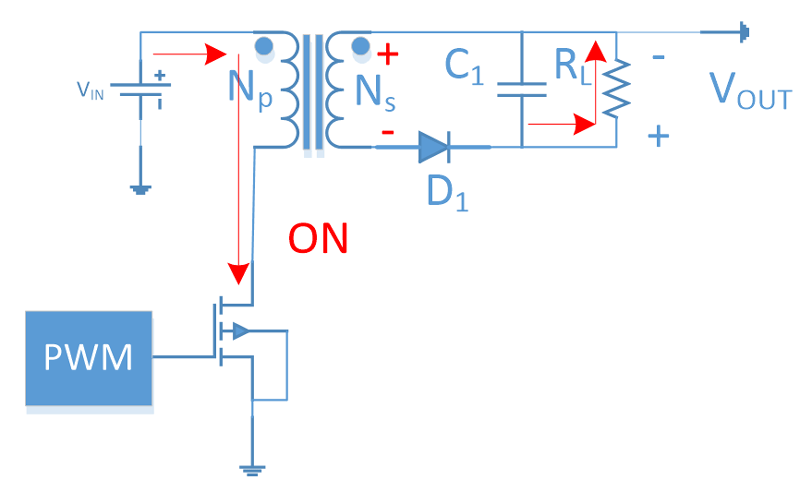
Hi, my name is Lisa Dinwoodie. I'm an applications engineer for Texas Instruments' Low Power Controllers and Converters Group. This presentation is a quick tutorial on the different types of flyback converters and the terminology used to describe them. The intent is not to go into design detail. But after this presentation, you should have a basic understanding of the different terms used to describe flyback converters, such as discontinuous, continuous, quasi-resonant, and valley switching. So let's get started. Let's begin with a quick review of the basics. What is a flyback converter? A flyback converter is a simple switch-mode power supply. Flybacks can be used to generate a DC output from either an AC or DC input. Flybacks are designed in such a way that the power from the input is transferred to the output during the off-time of the primary switch. They are generally used in the low- to mid- power range, usually less than 100 watts. There are several advantages to the flyback. This topology has a low parts count consisting of an input capacitor, a primary site switch, usually a MOSFET, a coupled inductor called the flyback transformer, an output rectifier, and an output capacitor to create a flyback converter. Thanks to the transformer, input to output isolation is possible. Careful design of the turns ratio between the primary and the secondary enable the output to be higher or lower than the input and also enables support of a wide input voltage range. A flyback can support multiple outputs by adding more windings to the transformer. The flyback converter uses a single magnetic, although commonly referred to as a transformer actually behaves as a coupled inductor. This transformer combines the functions of energy storage, energy transfer, and isolation, so the need for a separate LC filter on each output is eliminated. This greatly reduces the overall cost of flybacks as compared to other topologies. All flybacks have the same operating principle. When the MOSFET turns on, energy from the input source it's stored in the transformer, specifically, the gap in the transformer. This is much like filling a bucket from a well. Think of the source as a well and the transformer is the bucket. Because of the transformer winding scheme, noted by the dot polarity markings on schematic, the output diode is reverse-biased and off during the on-time of the MOSFET. When enough energy is stored in the transformer, the MOSFET switch is turned off, the bucket stops filling, and the diode now connects and energy from the transformer is delivered to the load. It is important to note that the MOSFET and the diode should never conduct at the same time. The bucket never empties while it's being filled. When the MOSFET turns on, this is referred to as the on-time of the converter. The input voltage is applied to the primary side of the transformer. The primary side current ramps up. During this time, the secondary side diode is reverse-biased, and the voltage applied to the diode is equal to the output voltage plus the reflected input voltage. The output capacitor supplies the load current during the on-time. When the MOSFET turns off, the current in the transformer transfers to the secondary and flows through the diode that is now forward-biased, replenishing the output capacitor and supplying the load. The secondary side current ramps down as the transformer core demagnetizes. During this MOSFET off-time, the primary side is considered an open circuit. The voltage applied to the MOSFET is equal to the input voltage plus the reflected output voltage. Note that the drain to source and the diode voltage equations shown here are simplified and do not account for the additional voltage stresses from circuit parasitics. A flyback is operating in Discontinuous Conduction Mode, or DCM, when the power stage is designed in such a way as to allow the transformer to completely demagnetize during each switching cycle. The simplest form of a DCM flyback is designed with a fixed switching frequency and modulates the peak current to support the load demands. At the start of the switch period, the on-time begins and the primary side current ramps up from zero. At the end of the on-time, the primary current collapses back to zero, and current flows to the secondary windings. It begins at its peak proportional to the turns ratio and ramps down to zero, completely demagnetizing the transformer during every switching cycle. After the demagnetizing time, there is a delay before the primary side switch turns on again to start the next switching cycle. This delay is referred to as dead-time or resonant time. During this portion of the switching period, neither the diode nor the MOSFET is conducting. This dead-time, where the transformer is completely demagnetized and no current is being conducted, is why this operating mode is called discontinuous, or DCM. During this dead-time, a resonant ring is generated by the interaction between the primary inductance of the transformer and the parasitic capacitance at the switch node. A converter in deep discontinuous mode can have a dead-time long enough for the resonant ringing to dampen completely, at which point the drain to source voltage will have settled to be equal to the input voltage. The high frequency ringing when the MOSFET is turned off is the result of the resonance formed between the leakage inductance and the switch node parasitic capacitance. Because the leakage inductance is much smaller than the primary inductance, this ringing will be at a much higher frequency than the resonant ring during the dead-time. This high-frequency ringing will add to the drain to source voltage stress, and it should be included in the voltage range of the MOSFET. For a fixed input voltage, increasing load demand results in longer on-time, allowing the peak current to rise higher. The amplitude of the peak current is modulated and the converter is operating in the AM-- or Amplitude Modulation-- range. The secondary side peak current will proportionally rise to a higher peak when the diode begins to conduct. And the dead-time portion of the switching period will decrease to maintain the constant switching frequency. The advantages of DCM flyback are that there are no reverse recovery losses in the output rectifier, because it's able to ramp down to zero amps during every switching cycle. The primary inductance value is lowest out of all the flybacks, which may result in a smaller transformer. A DCM flyback is inherently more stable, because it doesn't have a right-half-plane zero in its transfer function. DCM flybacks do have the disadvantage of very large ripple currents, which may require large EMI filters. Fixed frequency DCM flybacks have higher losses because they can turn off the switch when the drain to source voltage may be relatively high. It can be ringing higher than the input voltage at the moment of turn-off. This could contribute a considerable hit to efficiency, as the switching losses are proportional to the square of this voltage. Texas Instruments has a selection of controllers that support discontinuous flybacks, such as the UC2842 family of devices, the UCC28C40 family, and the UCC2800 family, and the LM5021. Valley switching is a specialized form of discontinuous conduction mode and requires a controller that is specifically designed to detect when the resonant ring during the dead-time is at a low point before turning the MOSFET on to start the next switching cycle, minimizing switching losses. In order to maintain the required average output power, the controller will modulate the switching frequency by skipping one or more valleys from one cycle to the next. Controllers that modulate the frequency to meet the average load demand every cycle are operating in FM, or frequency modulation, mode. This is sometimes also called frequency foldback, because as the load demand is decreased, the switching frequency is also decreased, or folded back. Valley switching can occur at any resonant valley during the dead-time, as long as it's large enough for the control to detect. The switching waveforms may appear to dither as the controller adjusts it's dead-time in its search for the nearest valley. Valley switch flybacks have all the advantages of traditional DCM flybacks with the added bonus of lower switching losses due to consistently turning the MOSFET off when the drain to source voltage is at a low value. This also helps to reduce the turn-on current spike at the current sense resistor. The dithering produced by valley skipping helps to reduce EMI. Unfortunately, valley skipping will result in higher output voltage ripple. Also valley switching is ineffective if the converter is operating in deep discontinuous mode, as the controller will not have enough of a signal to detect a valley. TI controllers that support Valley switching are the UCC28610, the UCC28720 and 722, the UCC28700 family, the UCC28704, and the UCC28710 family, UCC28730, and the UCC28740, along with the UCC28910 and 11. These controllers offer a variety of other features, such as cable compensation, thermal protection, primary side regulation, low power standby, et cetera. The details are provided in each data sheet found on the TI website. Quasi-resonant mode, or QR, may also be referred to as critical conduction mode or transition mode. Quasi-resonant operation is a specific valley switching operating mode of DCM where the switching occurs on the very first and deepest resonant valley. QR delivers the maximum amount of power by adjusting both the peak current and the switching frequency to turn the MOSFET on at the first resonant valley for minimal losses. QR controllers operate in AM and FM mode at the same time to meet the demands of energy transfer. QR controllers will decrease the switching frequency as the load increases. This is just the opposite of frequency foldback mentioned earlier. Most valley switching controllers, such as the ones mentioned previously, can operate in quasi-resonant mode, but only at the specific operating point of maximum load and minimum input voltage when designed accordingly. This limited QR range of operation is due to the control method used in the valley switching controllers, where only the frequency is modulated-- not both the frequency and the peak current, like in dedicated QR controllers. Because QR mode converters switch at the lowest drain to source voltage, they achieve the lowest possible switching losses and have high efficiency over the entire operating range. Because this is a soft switching converter, only small EMI filters are needed. QR converters are difficult to compensate due to the wide peak current and switching frequency ranges. Considerable phase margin is required to maintain stability over the entire operating range. The UCC28600 and the LM5023 are specifically designed for QR operation. But, as mentioned earlier, valley switching controllers can be used in a design that achieves QR mode at the minimum line and maximum load operating point. Let's talk about CCM now. CCM refers to continuous conduction mode. A continuous current is always flowing in the transformer during each switching cycle. When the MOSFET is turned on, the primary current ramps up. But it doesn't start from zero amps as in DCM, or discontinuous conduction mode. In CCM, the current ramps from an offset that is due to residual energy that is continuously maintained in the transformer. When the switches turned off, energy is transferred across the secondary and the transformer demagnetizes, resulting in the secondary side current ramping down. But it does not ramp all the way to zero amps. Residual energy is maintained in the transformer. The next switching cycle begins before the current is completely depleted. As shown, the current waveform on both the primary and the secondary is trapezoidal in shape. This is sometimes referred to as a ramp on a step. Note that there is no dead-time in CCM. Current is always being conducted somewhere in the transformer. But also note that despite continuously conducting current, the MOSFET and the diode do not conduct at the same time. As the load demand decreases, the store of residual energy, the step portion of the wave form, decreases. CCM flyback transformers are designed based upon the ripple current, or ramp portion, of the wave form, which is considerably less than the ripples seen in DCM flybacks. Controllers specifically designed for valley switching will not operate in CCM, as there is no resonant ring available and the transformer is not allowed to fully demagnetize. The advantages of continuous conduction mode, or CCM, are the small ripple and RMS currents, which result in lower capacitor losses. These lower currents also help lower conduction and turn-off losses when compared to DCM flybacks. Lower peak currents means smaller filter components. The most noted disadvantage of CCM flybacks is the presence of a right-half-plane zero in the power stage transfer function. This limits the bandwidth of the control loop and will impact the converter's dynamic response. Also, CCM flybacks require a larger inductance, which may require a larger magnetic component. The UCC28630 controller family is specifically designed for CCM operation, but there is nothing to limit using generic current mode controllers, such as the LM5021, the UC2842, the UCC28C40, or the UCC2800 device families in a CCM design. The operating point just on the cusp of DCM and CCM is referred to as the boundary condition. This is the operating point where the MOSFET is turned on at the precise moment when the transformer has demagnetized so there is no resonant ring. But at the same time, there is no energy stored in the transformer. There is no step or residual current stored. Converters that can operate in both CCM, as shown, will transfer through the boundary condition when it passes to DCM operating. CCM converters will pass through into DCM at very light loads. Because CCM has a more limited bandwidth, converters that allow passing from DCM to CCM should be compensated for CCM. Converters that require resonant valley detection to switch do not allow CCM, and so will not operate at the boundary condition. Now that the basic flyback mode terminology has been explained, you may be wondering which converter would be best for your application. Output power level and peak switching currents may help determine the optimum operating mode. Specific features, such as operating temperature range, turn-on and off thresholds, programmable soft start, low power mode, primary side regulation, high voltage startup, cable compensation, among others, will determine the controller most suited for the application Texas Instruments has a wealth of information available from our Power Supply Design Seminar series which is available to you. And this includes many topics specific for flybacks. Please visit ti.com/psds for more information. I hope this presentation was useful and helped to clarify the basic terminology used to describe flyback modes of operation. For more information on flyback converter design or any of the data sheets that the controllers mentioned, please consult the TI website. Thank you for your time.
- Flyback Converter Design In Pspice Tutorial
- Flyback Converter Ltspice
- Flyback Converter Design In Pspice Tutorials
Description
Valley switching, discontinuous, continuous, or quasi-resonant? This presentation demystifies the alphabet-soup nomenclature used to describe the different types of Flyback converters.
Let us compensate a buck converter operated in CCM and DCM 1. Run an open-loop Bode plot at full load, lowest input 2. Identify the excess/deficiency of gain at the selected cross over 3. Place a double zero at f 0, a pole at the ESR zero and a pole at F sw/2 4. Check final loop gain and run a transient load test Vout2 16 Cout 220u Resr 150m 2. The following tutorial describes how to design a boundary mode flyback circuit where the circuit operates on the boundary between continuous and discontinuous conduction. A typical flyback converter is shown in FIG 1. This circuit converts 12V to a pseudo-isolated 5V and can support a load of 1A. You should be able to simulate flyback transformer in PSpice. DO you have design parameters available with you? Based on that one can model the transformer model Let's take a example where Flyback primary is 1mH, turn ratio is 1:2, primary and secondary winding resistances are 1m & 2m ohms respectively Model would be.subckt FLBTR 1 2 3 4. Flyback inverter is a device that converters the DC into AC with the use of flyback transformer. For this inverter topology no dc-dc converter is required as the dc voltage is not related to the operation. It is simple, has less component count hence reduced cost and has advantage of isolation through transformer4. Let's see how it works.
Additional information
Fig. 1: Schematic of a flyback converter
The flyback converter is used in both AC/DC and DC/DC conversion with galvanic isolation between the input and any outputs. The flyback converter is a buck-boost converter with the inductor split to form a transformer, so that the voltage ratios are multiplied with an additional advantage of isolation. When driving for example a plasma lamp or a voltage multiplier the rectifying diode of the boost converter is left out and the device is called a flyback transformer.
Structure and principle[edit]
Fig. 2: The two configurations of a flyback converter in operation: In the on-state, the energy is transferred from the input voltage source to the transformer (the output capacitor supplies energy to the output load). In the off-state, the energy is transferred from the transformer to the output load (and the output capacitor).

Fig. 3: Waveform - using primary side sensing techniques - showing the 'knee point'.
The schematic of a flyback converter can be seen in Fig. 1. It is equivalent to that of a buck-boost converter,[1] with the inductor split to form a transformer. Therefore, the operating principle of both converters is very similar:
- When the switch is closed (top of Fig. 2), the primary of the transformer is directly connected to the input voltage source. The primary current and magnetic flux in the transformer increases, storing energy in the transformer. The voltage induced in the secondary winding is negative, so the diode is reverse-biased (i.e., blocked). The output capacitor supplies energy to the output load.
- When the switch is opened (bottom of Fig. 2), the primary current and magnetic flux drops. The secondary voltage is positive, forward-biasing the diode, allowing current to flow from the transformer. The energy from the transformer core recharges the capacitor and supplies the load.
The operation of storing energy in the transformer before transferring to the output of the converter allows the topology to easily generate multiple outputs with little additional circuitry, although the output voltages have to be able to match each other through the turns ratio. Also there is a need for a controlling rail which has to be loaded before load is applied to the uncontrolled rails, this is to allow the PWM to open up and supply enough energy to the transformer.
Operations[edit]
The flyback converter is an isolated power converter. The two prevailing control schemes are voltage mode control and current mode control (in the majority of cases current mode control needs to be dominant for stability during operation). Both require a signal related to the output voltage. There are three common ways to generate this voltage. The first is to use an optocoupler on the secondary circuitry to send a signal to the controller. The second is to wind a separate winding on the coil and rely on the cross regulation of the design. The third consists of sampling the voltage amplitude on the primary side, during the discharge, referenced to the standing primary DC voltage.
The first technique involving an optocoupler has been used to obtain tight voltage and current regulation, whereas the second approach has been developed for cost-sensitive applications where the output does not need to be as tightly controlled, but up to 11 components including the optocoupler could be eliminated from the overall design.[citation needed] Also, in applications where reliability is critical, optocouplers can be detrimental to the MTBF (Mean Time Between Failure) calculations. The third technique, primary-side sensing, can be as accurate as the first and more economical than the second, yet requires a minimum load so that the discharge-event keeps occurring, providing the opportunities to sample the 1:N secondary voltage at the primary winding (during Tdischarge, as per Fig3).
A variation in primary-side sensing technology is where the output voltage and current are regulated by monitoring the waveforms in the auxiliary winding used to power the control IC itself, which have improved the accuracy of both voltage and current regulation. The auxiliary primary winding is used in the same discharge phase as the remaining secondaries, but it builds a rectified voltage referenced commonly with the primary DC, hence considered on the primary side.
Previously, a measurement was taken across the whole of the flyback waveform which led to error, but it was realized that measurements at the so-called knee point (when the secondary current is zero, see Fig. 3) allow for a much more accurate measurement of what is happening on the secondary side. This topology is now replacing ringing choke converters (RCCs) in applications such as mobile phone chargers.
Limitations[edit]
Continuous mode has the following disadvantages, which complicate the control of the converter:
- The voltage feedback loop requires a lower bandwidth due to a right half plane zero in the response of the converter.
- The current feedback loop used in current mode control needs slope compensation in cases where the duty cycle is above 50%.
- The power switches are now turning on with positive current flow - this means that in addition to turn-off speed, the switch turn-on speed is also important for efficiency and reducing waste heat in the switching element.
Flyback Converter Design In Pspice Tutorial
Discontinuous mode has the following disadvantages, which limit the efficiency of the converter:
- High RMS and peak currents in the design
- High flux excursions in the inductor
Applications[edit]
- Low-power switch-mode power supplies (cell phone charger, standby power supply in PCs)
- Low-cost multiple-output power supplies (e.g., main PC supplies <250 W[citation needed])
- High voltage supply for the CRT in TVs and monitors (the flyback converter is often combined with the horizontal deflection drive)
- High voltage generation (e.g., for xenon flash lamps, lasers, copiers, etc.)
- Isolated gate driver

Flyback Converter Ltspice
See also[edit]
- Joule thief - Minimalist switchmode converter example
References[edit]
- Billings, Keith (1999), Switchmode Power Supply Handbook (Second ed.), McGraw-Hill, ISBN0-07-006719-8
| Wikimedia Commons has media related to Flyback converters. |
- ^The Flyback Converter - Lecture notes - ECEN4517 - Department of Electrical and Computer Engineering - University of Colorado, Boulder.
Flyback Converter Design In Pspice Tutorials
Retrieved from 'https://en.wikipedia.org/w/index.php?title=Flyback_converter&oldid=1012002599'